
Aigul Zabirova,
Chief Research Fellow,
Kazakhstan Institute for Strategic Studies under the President of the Republic of Kazakhstan
In Kazakhstan, higher education for women has long been the norm. After participation in education and the economy comes a more complex phase, the rethinking of values and roles within a generation. Why do young women and men view the distribution of family responsibilities differently, and how does this affect the future of the family and the economy?
Social change is usually measured in numbers such as the share of women in universities, women’s employment rates, and their representation across professions. In terms of gender indicators, Kazakhstan has come a long way, moving through the stage of expanding women’s access to higher education and the labor market. Higher education for women has long ceased to be unusual. Today, women are successfully integrated into both education and the economy. After participation comes a more subtle phase, the alignment of values and roles. This concerns society’s expectations of partnership, the distribution of family responsibility, and the right to make economic decisions. It is here that a more complex phase begins.
In a survey commissioned by the Kazakhstan Institute for Strategic Studies, respondents were asked to evaluate the statement, ‘If jobs are scarce, men should have a greater right to work than women[1]. When the responses are grouped into two categories, support for male priority and rejection of it, the following results emerge.
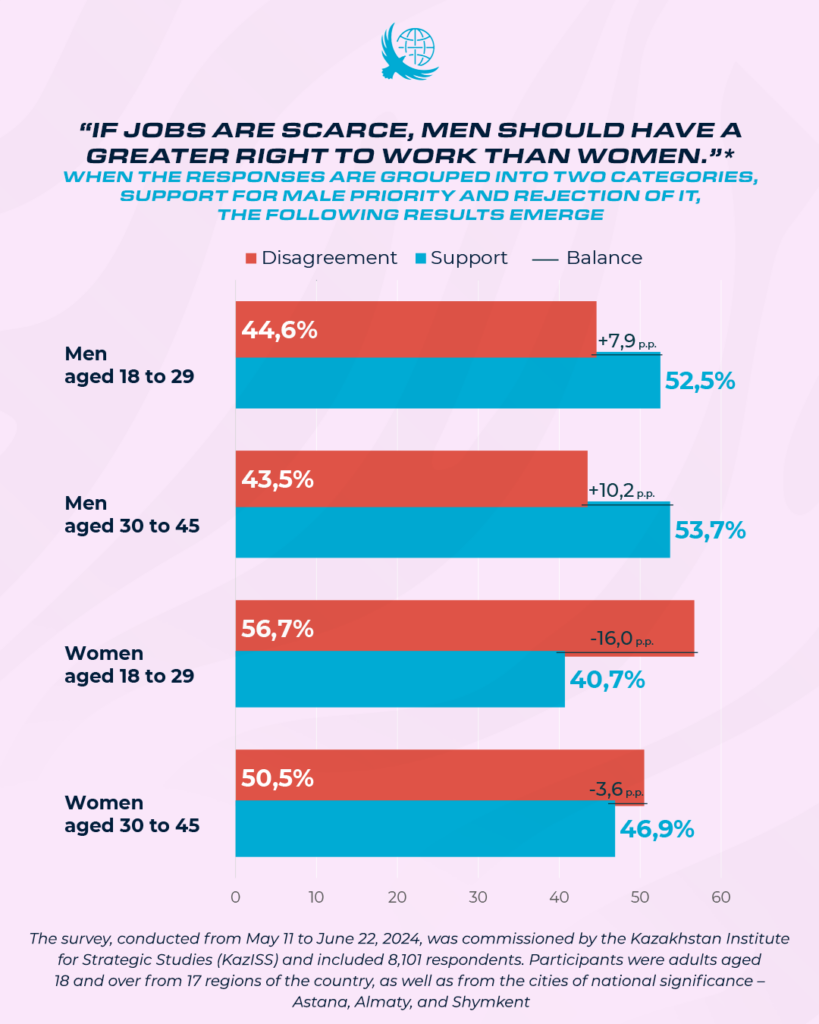
Among men aged 18 to 29, support for this idea is higher than among women of the same age, with a difference of approximately 24 points. This gap does not signal ideological conflict or radicalization. It reflects a divergence in the pace of value change. Young women are revising their understanding of partnership and the distribution of roles more rapidly, while the views of young men are shifting more gradually. Gender inequality is therefore no longer primarily expressed through unequal access to education, which is largely secured, but through differences in expectations and normative frameworks within the same generation.
In the social sciences, this dynamic is often described as the second phase of modernization. The first phase centers on women’s integration into education and the economy. The second phase concerns the transformation of family norms and everyday practices. As women gain economic independence, the perceived value of marriage changes, along with decisions about whether to have children and how many, and expectations regarding the quality of relationships. In East Asia and Europe, this stage was associated with later marriage and declining birth rates. When opportunities expand more rapidly than family roles adjust, tensions emerge that influence decisions about marriage and childbearing.
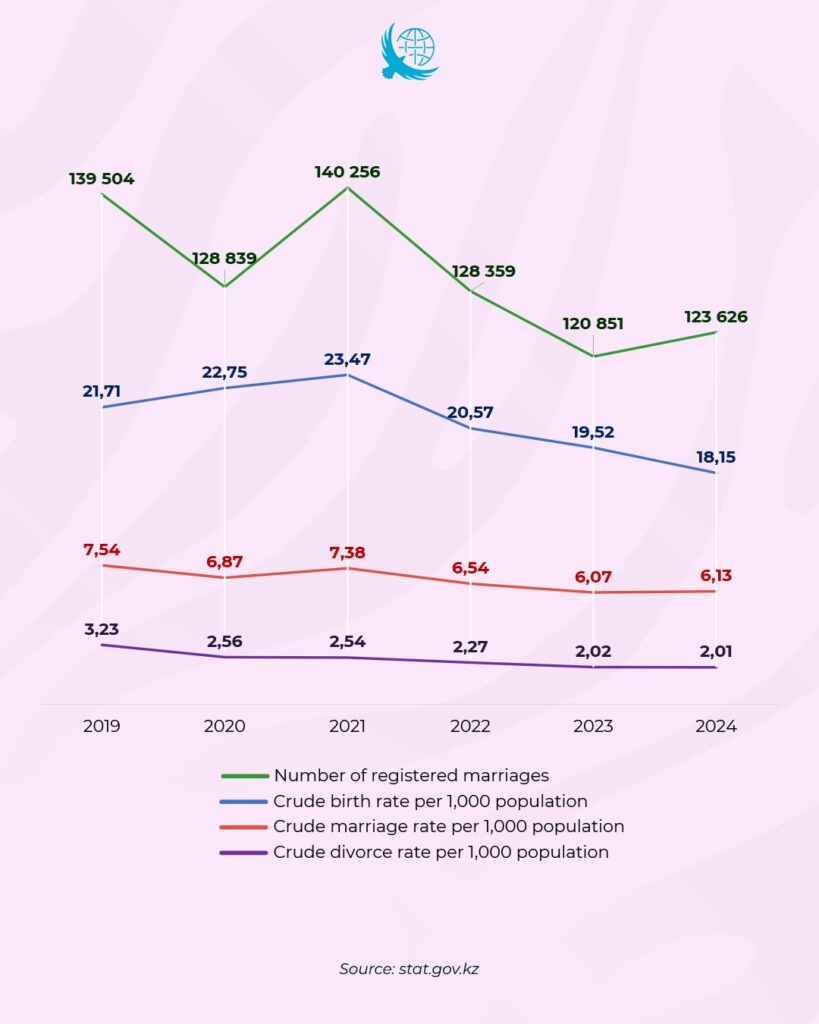
The demographic dynamics of recent years reinforce the sense of an ongoing demographic transition. After increasing in 2021, the crude birth rate declined by 2024[2]. During the same period, the marriage rate fell, the number of registered marriages decreased, and the divorce rate, after peaking in 2019, also began to decline. These trends require careful interpretation. They do not signal the breakdown of the family. Rather, they indicate a decline in the intensity of marriage as a social institution. People marry less often and, consequently, divorce less often. Under conditions of asymmetry in values and expectations within the family, women tend to become more cautious, marriage becomes more selective, and parenthood more deliberate. In this way, values increasingly shape economic and demographic behavior.
Family and gender policy still relies largely on the discourse of traditional values, demographic responsibility, and spiritual revival. These orientations remain important. However, the second phase of change requires institutional adaptation to a new social reality. Childcare services, flexible employment arrangements for young mothers, and fathers’ participation in childcare are developing more slowly than the values and expectations of younger generations are evolving. As a result, a dissonance emerges between formal equality and the actual distribution of family responsibilities. If this gap persists, it may constrain the effective use of human capital and affect long term demographic sustainability. This is not a conflict between men and women. It is a question of institutional responsiveness to social change. Formal equality alone is no longer sufficient. It is essential to create conditions in which equality can be realized in everyday life by supporting responsible fatherhood, taking regional specificities into account, and integrating gender equality into a broader agenda of social solidarity and social development.
Women’s integration into education and the economy has largely been achieved. A more complex stage is now unfolding, the alignment of values and roles. The sustainability of the future will depend on whether institutions are able to keep pace with these changes.
On the eve of International Women’s Day, we express gratitude to women for their contributions to the development of the country, the economy, families, and society. May the space of opportunities continue to expand, and may decisions about career, family, and personal paths be made freely and consciously. Happy International Women’s Day.
[1] The survey, conducted from May 11 to June 22, 2024, was commissioned by the Kazakhstan Institute for Strategic Studies (KazISS) and included 8,101 respondents. Participants were adults aged 18 and over from 17 regions of the country, as well as from the cities of national significance – Astana, Almaty, and Shymkent.
[2] https://stat.gov.kz/ru/industries/social-statistics/demography/