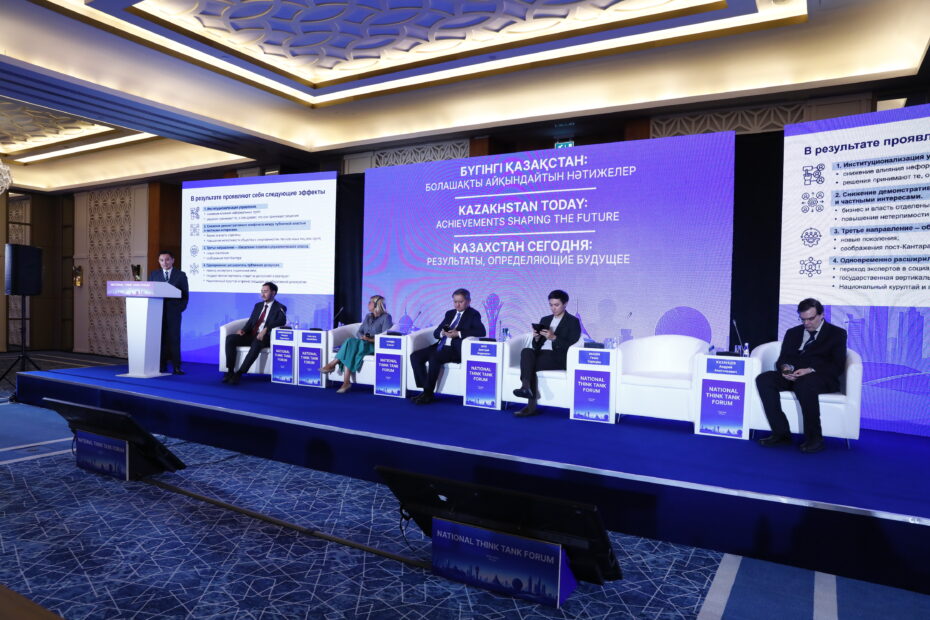
On August 21, the National Think Tank Forum, titled “Projecting the Future: From Reflecting on Results to a New Agenda,” was held in Astana. Government officials, heads of national think tanks, representatives of international organizations, and members of the expert and academic communities participated in the forum.
The forum served as a platform for a comprehensive discussion of Kazakhstan’s development achievements in recent years and for setting priorities for the next phase. The focus was on human capital, education and science, digital transformation and artificial intelligence, social resilience, economic and industrial development, energy, and Kazakhstan’s role in the evolving system of international relations.
The forum was moderated by Zhandos Shaimardanov, Director of the Kazakhstan Institute for Strategic Studies under the President of the Republic of Kazakhstan.
The first session, “Kazakhstan Today: Results That Shape the Future,” focused on assessing the key changes that have taken place in the country and the resources that form the foundation for its future development.
Katarzyna Wawiernia, the Permanent Representative of the United Nations Development Program in Kazakhstan, noted the country’s significant progress in improving quality of life, developing human capital, and advancing digitalization.
“Kazakhstan has laid a strong foundation for further development: a high level of access to education and employment is combined with the development of digital government services and a gradual transition to a more sustainable economic model,” noted K. Wawiernia.
Sayasat Nurbek, Minister of Science and Higher Education of the Republic of Kazakhstan, emphasized that Kazakhstan is gradually shifting from primarily exporting students to establishing its own international center for education and talent: there are 33 branches of foreign universities operating in the country, and more than 37,000 international students from 92 countries are studying at Kazakhstani universities. A separate area of focus is the integration of education, science, and new technologies.
“The combination of high-quality education, international talent mobility, artificial intelligence, and applied science forms the foundation for Kazakhstan’s transition to a knowledge-based economy,” S. Nurbek emphasized.
Dmitry Mun, CEO of Q.AI, highlighted a qualitative shift in the digital government model. Kazakhstan ranks 24th among 193 countries on the UN E-Government Development Index and is among the top 10 on the Online Services Index. This new phase involves the development of the National Artificial Intelligence Platform, the creation of AI agents, and the transition to data-driven governance.
Political scientist Gaziz Abishev suggested viewing the changes that have taken place since 2022 through the lens of a transition from stability to social resilience.
“Resilience is not the absence of change or mistakes. It is the ability to listen to public demands, correct mistakes, and implement necessary changes without losing control or public consensus,” emphasized G. Abishev.
The National Kurultai has become one of the mechanisms for translating public and expert discussion into government decisions: over the past four years, 26 laws have been enacted based on initiatives put forward by its participants.
Andrei Kazantsev, a professor at Narkhoz University, examined Kazakhstan’s opportunities amid the transformation of the world order. The expert identified Kazakhstan’s strategic resources as its multi-vector foreign policy, geographic location, natural resources, developed digital infrastructure, human capital, and a historically established culture of openness.
The second session of the forum, “The Agenda for the Future: Priorities and Solutions,” focused on directions for the country’s further development.
Zhuldizay Iskakova, Chair of the Board of the National Association “Kazakhstan Institute for Social Development,” noted that Kazakhstan is transitioning to a new phase of social development. According to the expert, studies show a high level of social optimism: 85.8% of Kazakhstani citizens are satisfied with their lives, and 60% expect further positive changes.
“The next step is to move from measuring individual indicators to a comprehensive assessment of the extent to which demographic, social, economic, technological, and institutional changes translate into well-being and new opportunities for people,” noted Zh. Iskakova.
Dastan Akebaev, Deputy Chairman of the Board of JSC “Institute for Economic Research,” emphasized that Kazakhstan remains the largest economy in Central Asia—by the end of 2025, Kazakhstan’s GDP reached 159.6 trillion tenge, or approximately 306 billion U.S. dollars. The country accounts for about 54% of Central Asia’s total GDP, and real economic growth over the past five years stood at 21.3%.
Eldar Gumarov, Chairman of the Board of JSC “Kazakhstan Center for Industry and Export QazIndustry,” highlighted the growing role of the manufacturing sector and non-resource exports. In 2025, the volume of Kazakhstan’s non-resource exports reached 29 billion U.S. dollars., an increase of 45% compared to 2021. The share of domestic products in the procurement of major entities amounted to 50.7%, or 14.9 trillion tenge.
Gulzhaina Eleusinova, Chair of the Board of JSC “A. Baitursynuly Taldau National Center for Educational Research and Assessment,” spoke about changes in the school education system. Kazakhstan is strengthening its position in international human development and education rankings.
“The development of educational infrastructure and the elevation of the status of teachers indicate that the next phase should focus on further improving the quality of education and creating equal opportunities for children regardless of where they live,” noted G. Eleusinova.
Alikhan Baidusenov, Senior Managing Partner at Energy Insights & Analytics, outlined the formation of a new energy architecture for Kazakhstan, which should combine modernized coal- and gas-fired power generation, renewable energy sources, nuclear power, and the development of grid infrastructure.
Following the National Think Tank Forum, participants concluded that Kazakhstan is entering a new stage of development with a solid foundation. At the same time, the new agenda requires a shift from quantitative results to qualitative changes: from access to education to the quality of human capital; from the digitization of services to a proactive government; from economic growth to technological sophistication and high value-added; and from stability to the ability of society and institutions to adapt to change. A common theme of the discussion was the need to view the results achieved not as the end point of reforms, but as a resource for the next stage of modernization.