
The family endures longer than any other social form invented by humankind, yet it is the family that first senses change. Today, women are working and increasingly pursuing careers, men are seeking ways to maintain their role and sense of purpose in a rapidly changing world, and the family is learning to live by new rules that no one has yet codified.

Aigul Zabirova,
Chief Research Fellow at the KazISS
under the President of the Republic of Kazakhstan
Although women in Kazakhstan, as in many other countries, have long been educated, entered the labor market, and assumed financial responsibilities, the situation in which a wife earns more than her husband significantly challenges traditional notions that a man should be the primary breadwinner. Nevertheless, families in which the woman is the main provider are increasing worldwide, representing a profound shift for the family as one of the earliest social institutions in human history. Yet this shift is not merely about finances; it reflects a fundamental change in the very logic of family life, where money and power no longer coincide in a single role.
Perspectives of the Kazakhstani population
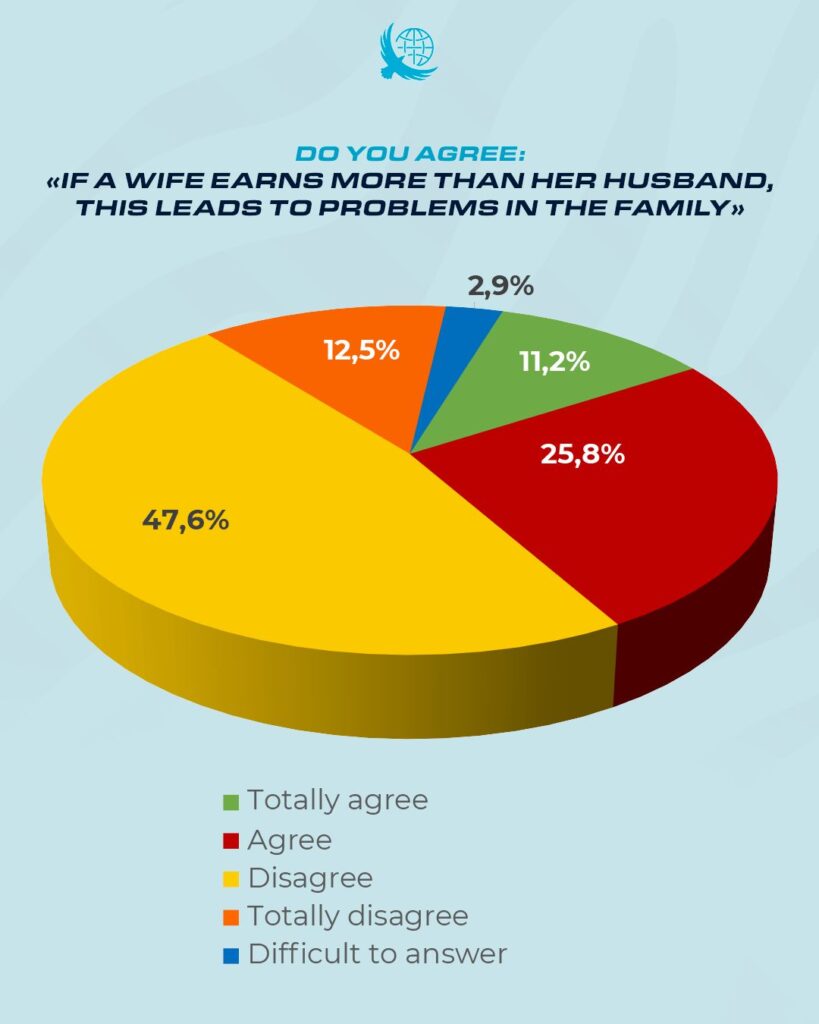
In one of the survey, respondents were asked to rate the statement “If a wife earns more than her husband, it causes problems in the family”. In general, the question seems simple, but there is a whole layer of feelings, expectations, and fears behind it. What happens when the usual order turns upside down, and she becomes the main income-earner in the house?
As survey results show, the majority of Kazakhstanis (60.1% of respondents) do not view this situation as alarming, while a third (37% of respondents) still believe that such a scenario could lead to problems within the family (Pic. 1). Overall, it is clear that contemporary understandings of family roles in Kazakhstan are beginning to supersede traditional ones, yet the older notion of the man as the primary income-earner remains influential.
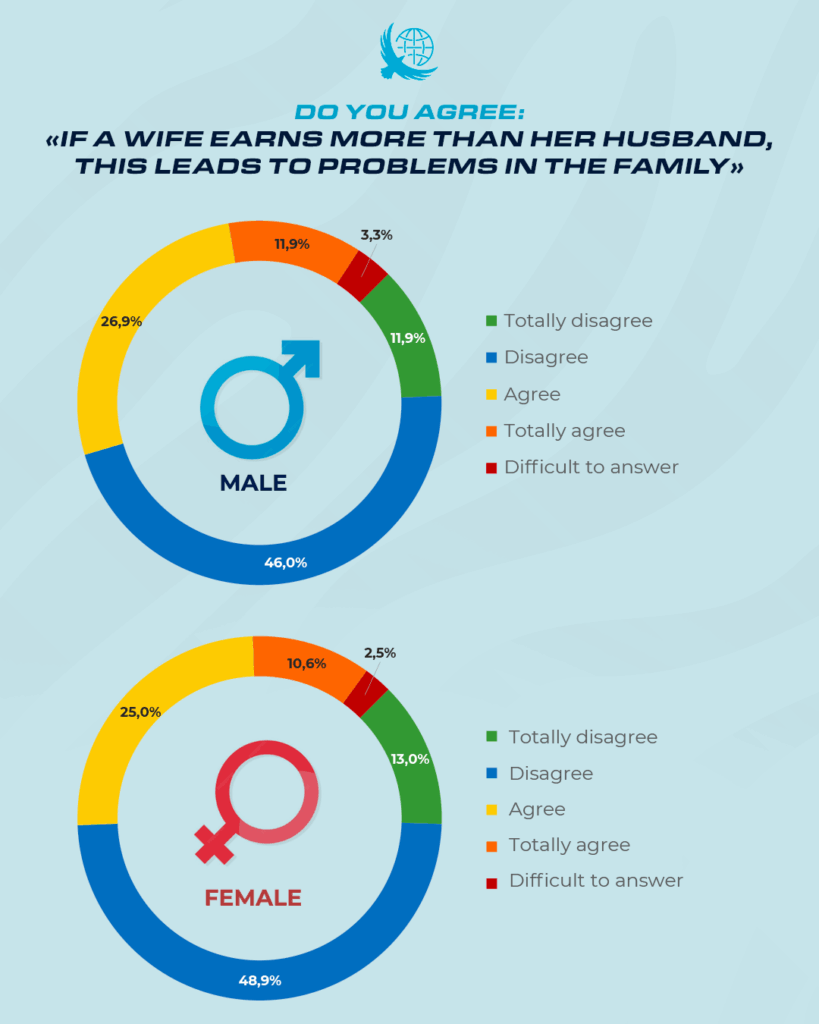
A closer look reveals that men experience greater concern. Nearly 39% of men agree with the statement that ‘a wife earning more causes problems in the family,’ compared to 36% of women. Although the difference is small, it indicates that men are more likely to associate income with a sense of personal dignity, whereas women tend to link it to the ability to support the family (Pic. 2).
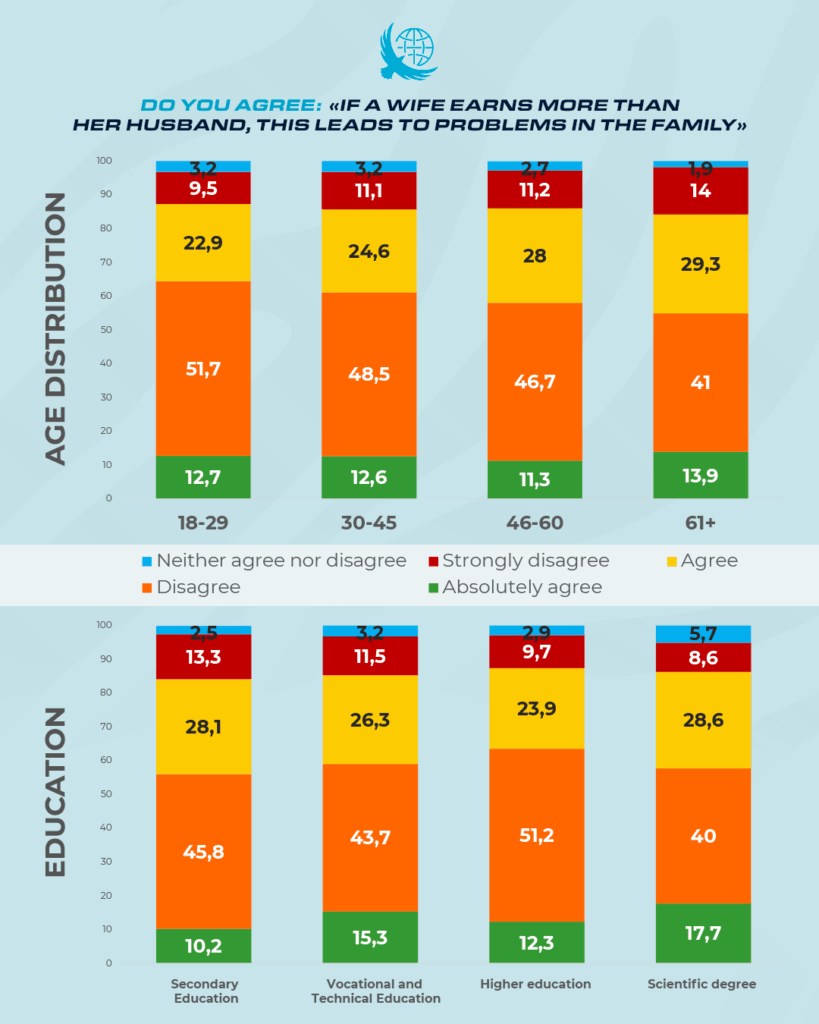
Anxiety increases with age. The majority of young people under thirty approach this situation calmly, with only one in three perceiving it as a threat. In contrast, the older generation, particularly those over sixty, adhere to the traditional model in which ‘the man should be the head of the household’ (Pic. 3).
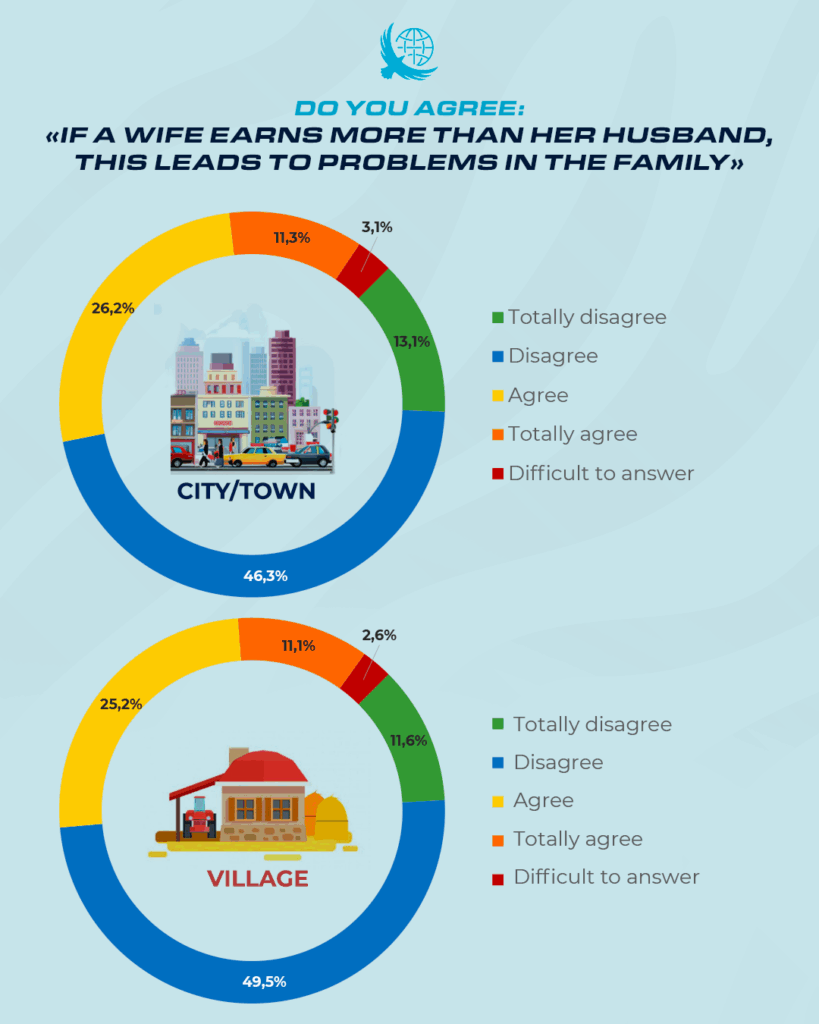
Interestingly, patriarchal and modern ideas live side by side not only in rural areas, but also in urban areas, since there is practically no difference between villagers and citizens in this matter (Pic. 3).
The higher the level of education, the lower the anxiety, since highly educated Kazakhstanis do not perceive this situation as problematic (Pic. 4).
This issue is most sensitive for individuals with low incomes. The lower the income level, the stronger the belief that inequality favoring the wife leads to problems within the family. In low-income households, money is more often associated with power and control, and any shift is perceived as a threat to the established order. Conversely, the higher the level of financial well-being, the more tolerant the attitude toward such situations.
Religiosity exerts a significant influence. Among practicing adherents, nearly half concur that “a wife with a higher income” disrupts the familial balance. In contrast, among moderately religious and non-religious individuals, this view is held by only about one-third. In this context, religious belief functions as a cultural anchor, reinforcing traditional gender-role frameworks, wherein the male assumes the role of provider and the female that of household caretaker.
The Way from Competition to Collaborative Partnership
What do all these differences mean? They are less about money than about the ways we have been accustomed to understanding power and care. Money acts as a tell-tale sign, revealing longstanding beliefs that the man is the head of the household while the woman is responsible for the home and caregiving. Thus, when a wife begins to earn more, the conventional understanding of family life begins to crack. Yet this does not imply the destruction of families or relationships; rather, it reflects a search for new forms of stability. Today, we are learning to live in a world where material wealth no longer equates to power, and respect for one’s partner matters more than who earns the higher salary. Increasingly, women are becoming not assistants but equal participants in shared life. This, in turn, transforms the very logic of the family—from hierarchy to partnership.
The Situation in the Global Arena
As the number of women earning more than their husbands increases worldwide, it becomes interesting to consider Kazakhstan’s position on this global scene. It is important to note that we are not an exception; in many countries where it was once assumed that men should be the primary providers, similar situations evoke comparable reactions. In post-Soviet societies, the situation largely mirrors our own: the majority have come to accept this change with relative ease, yet traditional beliefs continue to persist beneath the surface. In the West, gender equality is strongly established both legally and rhetorically, but not always emotionally. Sociological research in the United States indicates that couples in which wife earns more than husband are less likely to describe their marriages as “very happy.” Swedish studies – Sweden is considered as an ideal country in terms of gender equality – have shown that men whose wives earn more are more frequently diagnosed with mental health disorders and depression.
In contrast, rigid gender-role divisions persist in East and South Asia. In Japan, for example, a man’s career remains the primary determinant of family status, whereas in China, couples are increasingly building their careers on an equal condition. Moreover, there are instances in China where men assume the role of homemaker, while respecting and supporting their wives’ professional success. In Middle Eastern countries, particularly those with predominantly Muslim populations, the question of women’s income remains largely taboo, often perceived as a threat to male dignity and self-esteem. Yet even in these contexts, among young and educated urban populations, an increasing number of individuals recognize the benefits of dual-income households and no longer dramatize situations in which the wife earns more. Over time, economic realities are slowly but steadily reshaping these deeply ingrained social norms, reflecting a broader evolution in attitudes toward gender, work, and family life.
However, this phenomenon also has another side. In the Gulf Region, a significant number of women from the Philippines and Bangladesh work as nannies, housekeepers, or hairdressers, sending money home to children and often unemployed husbands. Although these women are not top executives, they have become the primary breadwinners, paying for this role with long periods of separation from their families. In societies where men are unemployed and women earn the income, traditional gender roles are disrupted – not by choice, but by necessity.
In this context, Kazakhstan – where six out of ten individuals perceive no cause for concern. While we no longer live in the traditional world, full gender equality has yet to be realized. This may be precisely why this discussion is so significant: it exposes how deeply entrenched the tendency remains to equate love with financial contribution.
What is behind this Phenomenon
Behind these figures lie not merely opinions, but the realities of people’s lives. In households where the wife earns more, daily life often functions as an ongoing negotiation: the husband strives to preserve his sense of self-respect, while the wife seeks equilibrium within the relationship. Some couples manage to achieve a balance, transforming the family into a genuine partnership, whereas others remain caught between pride and resentment. This is not a battle of the sexes, but rather a clash of eras, in which the traditional model – “the man as primary breadwinner” – is in decline, yet not fully displaced, and the emerging model of shared responsibility – “we work together” – is still taking shape. It is this transitional dynamic that may ultimately shape our understanding of family in the future.
The survey, commissioned by KazISS, was conducted from May 11 to June 22, 2024, and included 8,101 respondents. Participants were adults aged 18 and older from 17 regions of the country, as well as the cities of national significance – Astana, Almaty, and Shymkent.