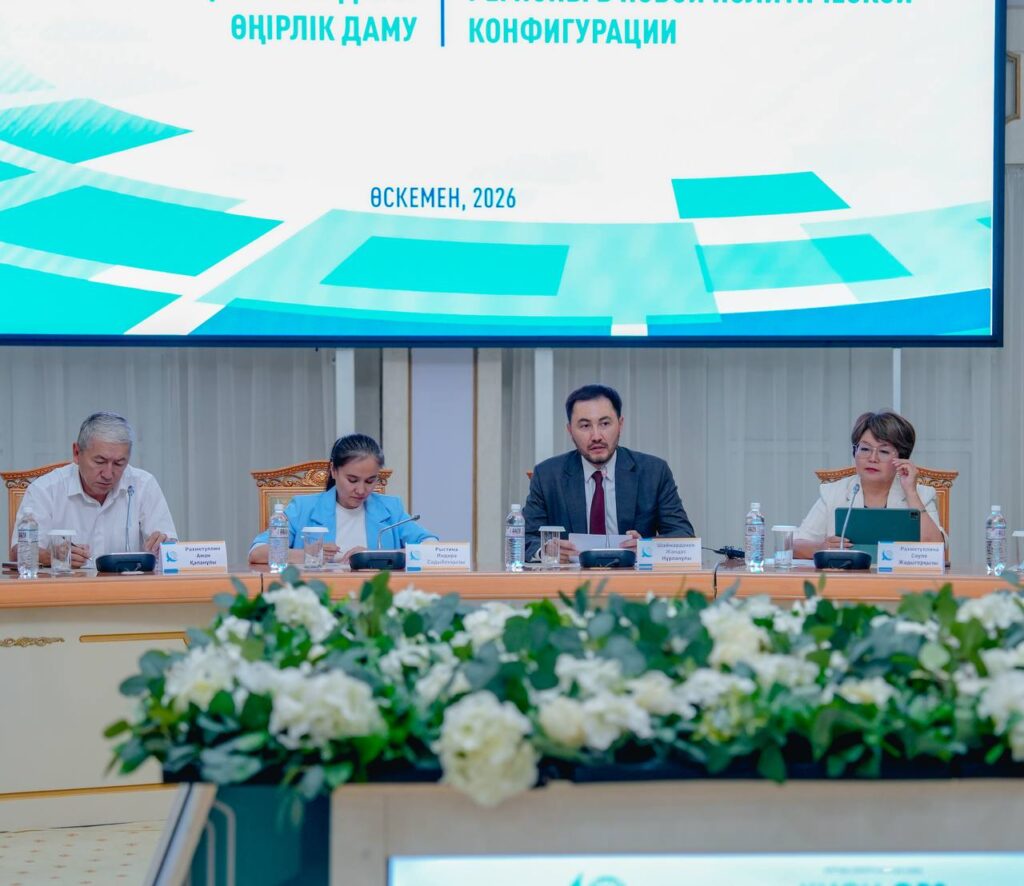
On August 4, a meeting of the National Expert Platform “KazISS GPS: Gylym. Pikir. Sayasat” was held in Oskemen at the D. Serikbayev East Kazakhstan Technical University. The meeting focused on the topic “Saylau-2026: Regions in the New Political Configuration.” The event was organized by the Kazakhstan Institute for Strategic Studies under the President of the Republic of Kazakhstan (KazISS).
The discussion brought together representatives of leading think tanks, the academic and expert communities, higher education institutions, and civil society organizations. Experts discussed the upcoming elections to the Kurultai, the changing role of regions in the new political system, the development of political party and public representation, as well as mechanisms for incorporating regional priorities into national decision-making.
Opening the meeting, Zhandos Shaimardanov, Director of KazISS under the President of the Republic of Kazakhstan, noted that the current electoral campaign represents the first practical stage in implementing Kazakhstan’s new constitutional model.
The Director of KazISS also highlighted changes in electoral attitudes. According to sociological research, 70–76% of citizens currently express their willingness to participate in the vote, while the share of undecided voters has declined from more than 22% in June to around 8% by the end of July.
Zhandos Shaimardanov placed particular emphasis on the growing importance of the regional agenda.
“Elections reflect public sentiment and the real needs of citizens. Each region has its own priorities — industrial development, rural areas, environmental issues, water supply, transport, or demographics. That is why the importance of the regional agenda in the performance of the future Kurultai will only increase,” he emphasized.
Saule Rakhmetullina, Chairperson of the Board and Rector of D. Serikbayev East Kazakhstan Technical University, noted that constitutional reforms increase the responsibility of regions for their own development. In 2025, industrial output in the East Kazakhstan Region exceeded 3.3 trillion KZT, underscoring its strategic importance to the national economy.
“The competitiveness of a region today is determined by how effectively it utilizes its industrial, scientific, investment, and human potential,” Saule Rakhmetullina emphasized.
Political scientist Talgat Kaliyev focused particular attention on the issue of regional representation under the transition to a unicameral Parliament. In his view, while the Senate previously played a significant role in representing regional interests, this responsibility now increasingly falls on political parties, which have an interest in ensuring broad representation from all regions of the country.
“No party can expect nationwide support if its lists do not include strong and reputable candidates from different regions. Therefore, political competition itself will encourage parties to build genuinely nationwide teams,” Talgat Kaliyev noted.
According to him, this model will enable regions to be represented not by individual deputies, but by party teams backed by expert resources, analytical support, and the capabilities of parliamentary factions.
“The interests of the regions will be advanced not through the efforts of a single deputy, but by the political party as a whole, making such representation more sustainable and effective,” the expert emphasized.
Indira Rystina, Member of the Board and Vice-Rector of L.N. Gumilyov Eurasian National University, noted that the transition to a proportional electoral system strengthens the role of political parties, their programmes, and their teams. According to her, all political parties have regional branches and are already engaged in systematic work on the ground. Therefore, the quality of party programmes is becoming a key factor in electoral competition.
“During the election campaign, parties should place the main emphasis on their programmes and the commitments they present to voters. At the same time, regional policy and the challenges faced by individual territories should become an integral part of these programmes, since residents of the regions constitute the majority of the electorate,” Indira Rystina noted.
The expert added that the new model shifts competition away from the personal visibility of individual candidates toward competition between party programmes, ideas, and teams. This requires political forces to maintain a permanent presence in the regions and incorporate local priorities into national policy.
Azamat Baigaliyev, Deputy Chairperson of the Board of the Kazakhstan Institute for Public Development, noted that the elections to the Kurultai represent an important stage in shaping a new political culture in Kazakhstan. According to him, the regular holding of elections and referendums is becoming a new norm of the country’s social and political life.
According to the latest sociological research, expected voter turnout stands at around 75%. In addition, 84% of citizens assess the socio-political situation in the country as stable and favorable, while more than 80% look to the future with optimism.
“Voters are becoming more demanding. Today, citizens expect not loud slogans, but professional solutions to specific problems — from inflation and job creation to infrastructure development, housing and utilities, and road quality,” Azamat Baigaliyev emphasized.
Boris Polomarchuk, a member of the Public Council of the Pavlodar Region, presented an analysis of party lists from the 2016, 2021, and 2023 elections, as well as relevant sociological studies. According to him, despite the broader geographical distribution of candidates, party recruitment during previous parliamentary campaigns remained highly centralized: around 43% of candidates were associated with Astana, while more than 65% of parliamentary mandates went to representatives of the capital. At the same time, the regions, which accounted for almost 40% of candidates, received less than 20% of parliamentary seats. In the expert’s view, these disparities need to be addressed, and political parties should strengthen their regional branches.
“A regional branch should become not an administrative office, but a political and analytical center that studies the challenges facing the territory, engages with experts, and promotes regional initiatives to the national level,” Boris Polomarchuk emphasized.
Aman Rakhmetullin, Head of the Department of Social Sciences and Humanities at Alikhan Bokeikhan University, devoted his presentation on the development of political culture amid constitutional reforms. According to him, the expansion of citizens’ participation in government decision-making is reflected both in electoral engagement and in the development of local self-government institutions.
“The development of political culture should be assessed not only through legal changes, but also by the level of citizens’ political activity, their participation in public life, and their trust in state institutions,” Aman Rakhmetullin emphasized.
Rufit Akhmedzyanov, Director of the public foundation “Center for Local Self-Government Development,” noted that citizen participation should not be limited to election day.
“Public councils, local self-government, and public consultations should ensure an ongoing dialogue between the state and society, while timely reflecting the needs and priorities of the regions,” he said.
Summing up the meeting, participants emphasized that under the new political model, the regions should become full-fledged participants in shaping the national agenda. To achieve this, it is necessary to strengthen cooperation among government bodies, political parties, universities, think tanks, and civil society organizations, while expanding the participation of regional experts in the preparation of government decisions.