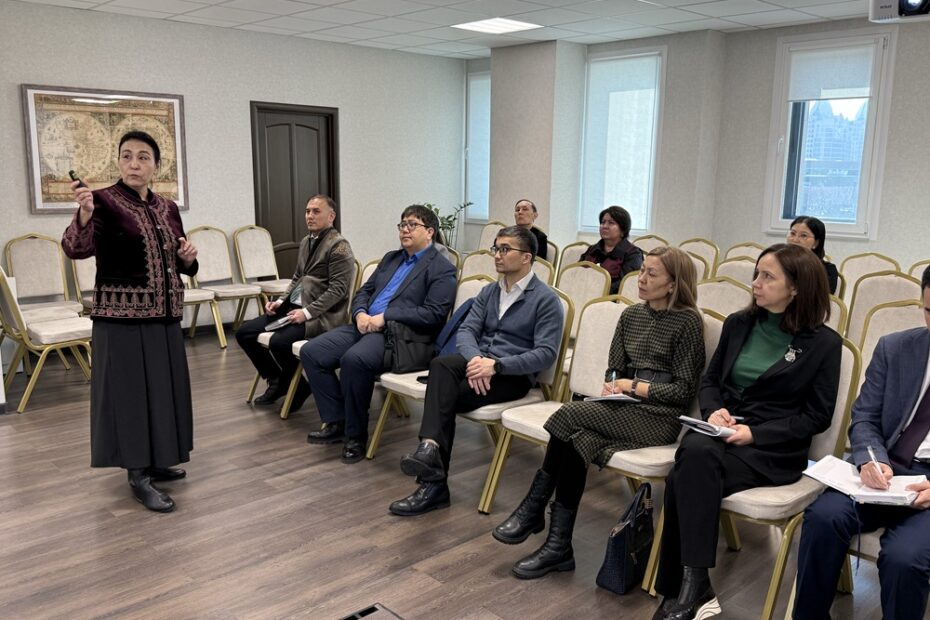
A lecture by Aigul Kosherbayeva, Academic Secretary of the Kazakhstan Institute for Strategic Studies under the President of the Republic of Kazakhstan (KAZISS), Doctor of Economics, and Professor, on the topic Data Management in a Doctoral Dissertation was held for doctoral students of the Academy of Public Administration under the President of the Republic of Kazakhstan.
The event was organized as part of the educational program and was aimed at developing the research competencies of the Academy’s students in the field of public administration.
During the lecture, Professor A. Kosherbayeva provided a detailed overview of the key approaches to working with data in the preparation of doctoral research in public administration and economics. Particular attention was paid to the fact that a modern doctoral dissertation is not only an academic text, but also a complex body of heterogeneous data requiring a systematic and structured approach.
The lecturer emphasized that structured data form the foundation of any breakthrough scientific research. In this regard, systematic data management is viewed not merely as a technical skill, but as a necessary condition for preparing a dissertation capable of withstanding rigorous academic review.
It was also noted that the time invested in organizing data at the initial stage of research pays off many times over by improving the accuracy of conclusions, accelerating analytical work, and strengthening the persuasiveness of the results during the dissertation defense.
The lecture attracted considerable interest among the doctoral students and was accompanied by an active discussion, during which participants addressed practical tools and modern approaches to scientific data management.
Holding such events contributes to strengthening cooperation between research and educational institutions, as well as to improving the quality of training for academic personnel.